AI coding agents often demand broad repository access. For enterprise developers, freelancers under NDA, and privacy-conscious engineers, that access is a non-starter.
The question isn’t whether AI can help. It’s whether you can use it without handing over unrestricted access to sensitive code, credentials, or customer data.
The answer is yes, if the architecture puts you in control.
Recent Incidents Highlight the Risk
Recent reports of repository uploads and prompt-injection vulnerabilities show why developers need visibility into exactly what leaves their machine. An agent’s stated file-access rules or a provider’s policy are not the same thing as a technical boundary around proprietary code.
What “Air-Gapped AI Coding” Really Means
True air-gapping keeps both the model and codebase fully offline. Selectively sharing code with a cloud chat is a different arrangement. Here are three common setups:
- Fully local AI: Everything stays on your hardware. Maximum privacy, but higher hardware demands and potentially weaker model performance.
- Local-first, selective disclosure: The repository stays local. A trusted local tool prepares limited, reviewable context that you manually paste into an approved cloud chat.
- Cloud-connected agents: Broad repository access with automation. Most convenient, with the largest trust boundary.
Local-first, selective disclosure can fit teams allowed to share reviewed snippets with a cloud service but unable to grant it repository access.
Privacy Policies Aren’t Technical Boundaries
Provider policies matter, but they do not solve data minimization. Even enterprise-oriented tools can send more context than a task requires. The safer approach is to minimize disclosure before anything reaches the provider.
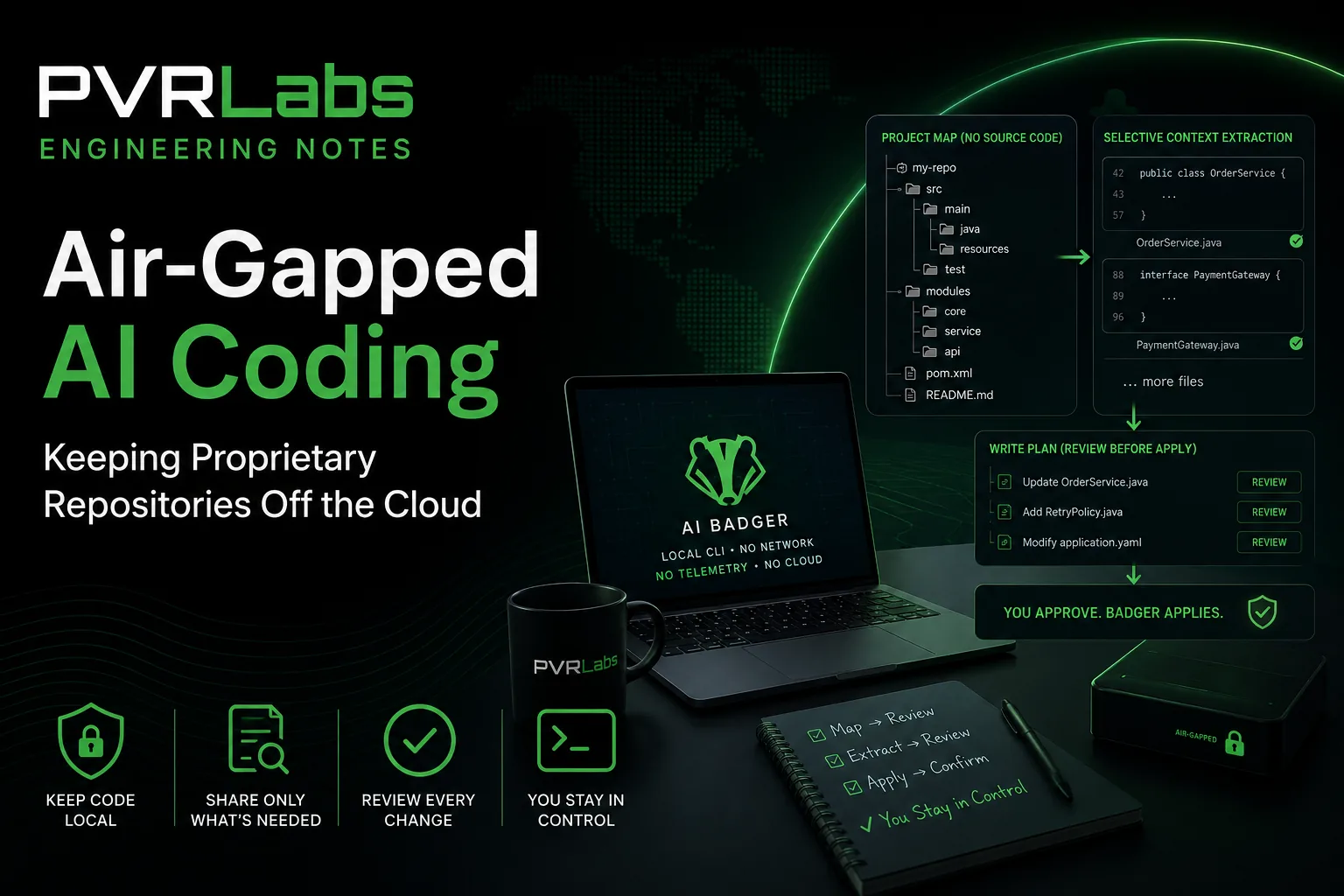
The Secure Workflow: Map → Extract → Apply
A strong local-first tool should keep three operations visible and controllable:
- Map the repository structure, including languages, modules, and files, without sending source code.
- Extract only the specific files or spans the AI requests.
- Apply changes only after you review the write plan.
AI Badger implements this model as a local CLI with no network calls, telemetry, or cloud dependency. It acts as a strict buffer between your repository and an AI chat such as ChatGPT, Claude, or Grok.
A Simple Workflow
1. Describe task → Badger generates a project map (no source code)
   ↓ You review and copy it to chat
2. AI requests specific context → Badger extracts → You review
   ↓ You copy approved context to chat
3. AI suggests changes → Badger shows a write plan → You confirm
This creates explicit gates on both outbound disclosure and inbound modifications.
The Clipboard Is Part of the Boundary
Copy-paste feels less “agentic”, but that explicitness is the feature. Every transfer is deliberate. Endpoint security still matters, of course: clipboard managers and remote-access tools can observe content.
When This Approach Fits
- Enterprise teams allowed to use web chats but not repo-indexing extensions
- Freelancers working under strict NDAs
- Engineers handling credentials, unreleased features, or customer data
- Teams using multiple AI providers without per-vendor integrations
It trades some automation for visible control, which is ideal for architecture, debugging, reviews, and focused implementation.
A Practical Conservative Process
- Confirm the target AI service is approved.
- Run Badger locally and review the project map.
- Let the AI request only what it needs.
- Review extracted source before sharing.
- Review and confirm all proposed writes.
- Run tests, linting, and secret scans before committing.
Conclusion
Secure AI coding requires both an approved provider and control over what you send to it.
Keep the repo local. Expose only narrowly selected, human-reviewed context. Require confirmation on every write.
AI Badger is built for this controlled-disclosure model: it keeps your proprietary code under your control while letting you use the cloud reasoning you choose.